The Electoral Commission has released an official progress update on the implementation of activities under the Roadmap for the 2026 General Elections, outlining key milestones achieved so far and adjustments made to ensure a credible, inclusive, and well-coordinated electoral process.
In a statement delivered on Wednesday, 17th December 2025, the Chairperson of the Electoral Commission briefed political parties and organisations, civil society actors, election observers, and members of the media on the state of preparedness for the forthcoming elections. The update forms part of the Commission’s statutory obligation to keep stakeholders informed and engaged throughout the electoral cycle.
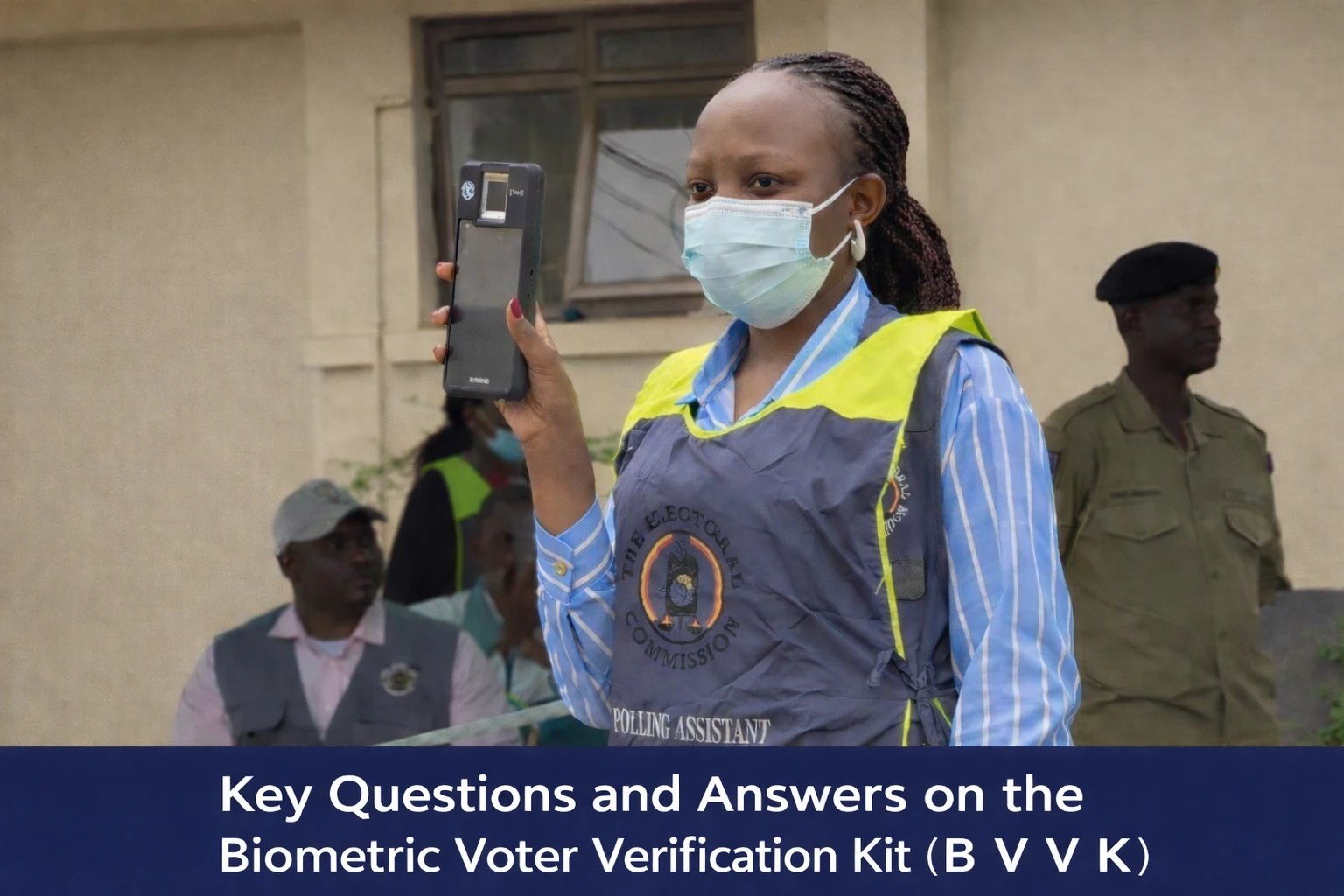
The Commission reaffirmed its commitment to transparency and electoral integrity, noting that preparations for the 2026 General Elections are progressing in line with the approved roadmap. As part of the engagement, the Commission also conducted a public demonstration of the Biometric Voter Verification System, underscoring its continued reliance on technology to enhance accuracy, efficiency, and public confidence in the electoral process.
Adjustment of Polling Dates for Special Interest Groups Elections
Within the framework of ongoing preparations, the Electoral Commission announced adjustments to the polling dates for the election of representatives of Special Interest Groups at both Parliamentary and Local Government Council levels. The Commission explained that the revisions were made to ensure better logistical coordination, adequate stakeholder participation, and compliance with the broader electoral timetable leading to the 2026 General Elections.
Special Interest Groups remain a critical pillar of Uganda’s inclusive democratic architecture, providing representation for groups such as youth, workers, persons with disabilities, older persons, and women within the legislative and local governance structures. The timely and orderly conduct of these elections is therefore essential to safeguarding equitable participation in national decision-making.
To provide clarity and facilitate planning by stakeholders, the Commission has issued a revised schedule outlining the new polling dates for the affected Special Interest Groups elections. The updated dates are presented in the table below and take immediate effect.
Table: Revised Polling Dates for Elections of Representatives of Special Interest Groups (SIGs) at Parliamentary and Local Government Council Levels
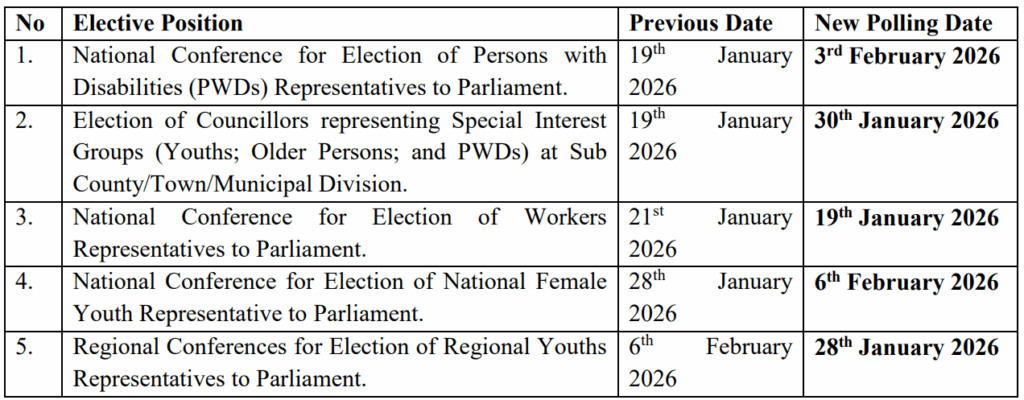
The Commission explained that the above adjustments were undertaken to ensure that members of the affected elective categories are able to fully participate in the 2026 General Elections conducted under universal adult suffrage, while also effectively engaging in their respective electoral college elections.
It was further clarified that polling dates for all other elective positions remain unchanged and continue to be governed by the previously issued electoral schedule, which is publicly available on the Electoral Commission’s official website.
Commencement of Issuance of Voter Location Slips
As part of measures aimed at improving voter convenience and reducing incidents of voter disenfranchisement, the Electoral Commission has commenced the nationwide issuance of Voter Location Slips. The exercise began on 15th December 2025 and will run until 13th January 2026.
The slips are being issued at every Parish and Ward across the country in accordance with schedules issued by respective Parish and Ward Supervisors. The initiative responds to concerns raised in previous electoral cycles, where some voters experienced difficulty locating their designated polling stations on polling day.
Each Voter Location Slip contains key voter particulars, including the voter’s photograph, full names, date of birth, and polling location details covering the district or city, constituency, sub-county, parish, and specific polling station. In addition, the slip bears a unique barcode that will be read by the Biometric Voter Verification machines to be deployed at all polling stations during the elections.
The Commission noted that the Voter Location Slip will be used across four electoral cycles during the 2026 General Elections: the Presidential and Parliamentary elections; the District and City Chairpersons and Councillors elections; the Municipality and City Division Chairpersons and Councillors elections; and the Sub-county, Town Council, and Municipal Division Chairpersons and Councillors elections.
The Commission emphasised that the Voter Location Slip is issued free of charge and must be collected in person by the registered voter from the Parish or Ward Supervisor, who is an employee of the Electoral Commission. Voters have been advised to keep the slips secure and ensure that the barcode remains intact and untampered with. Only voters whose particulars appear on the Polling Day Register are eligible to receive a Voter Location Slip during the ongoing issuance exercise.
Deployment of Biometric Voter Verification Kits for the 2026 Elections
In further strengthening the integrity of the electoral process, the Electoral Commission has procured 109,142 Biometric Voter Verification Kits for deployment during the 2025/2026 General Elections. The kits will be used to authenticate voter identity through fingerprint and facial recognition technology.
The system will enable Presiding Officers to confirm that a voter presenting at a polling station is duly registered at that specific location, thereby preventing multiple voting, impersonation, and other electoral malpractices. This technological intervention is intended to reinforce the constitutional principle of one person, one vote.
The Commission reported that training of electoral officials to operate the Biometric Voter Verification Kits is ongoing, spanning from the national level down to polling station officials. As part of stakeholder engagement and transparency, the Commission conducted a public demonstration of the Biometric Voter Verification System to familiarise political actors, civil society, observers, and the media with its functionality.
The demonstration was intended to sensitise stakeholders on polling day procedures, illustrate how biometric and facial recognition verification is conducted, and build public confidence in the system. It also provided an opportunity for stakeholders to observe the technology in operation, seek clarification on safeguards against electoral fraud, and gain a deeper understanding of how technology is being leveraged to enhance the credibility, transparency, and efficiency of the 2026 General Elections.